

Bourbon Regulations: The Law, The Loophole, and The Truth
By Gregg Snyder, Master Distiller
The Law of the Liquid: Why Bourbon Regulations Are the Only Thing Standing Between You and Swill
Most people think government regulations are bureaucratic nonsense. Red tape. A hindrance to business. In the world of whiskey, they’re wrong.
If you care about what’s in your glass, the Code of Federal Regulations is as much a weapon as it is a legal text. It’s the only thing stopping a massive industrial complex from selling you vodka flavored with wood chips and calling it "heritage." At Four Branches, we built our foundation on service and integrity. We don't cut corners. But the shelf at your local liquor store is a minefield of half-truths. You need to know how to navigate it.
To understand our story, you have to understand the rules of the game. Because once you know the law, you can spot the liars.
The Federal Standard: Defining "America's Native Spirit"
Let’s cut through the marketing fluff. You see bottles claiming "Smooth," "Craft," or "Small Batch." Those words mean absolutely nothing. They are unregulated marketing terms. You can distill a million gallons in a factory, put it in a bottle, and call it "Small Batch."
But “bourbon”? That means something.
Here is the only definition that matters (27 CFR § 5.143):
To be legally labeled as Bourbon Whiskey, the spirit must be produced in the United States from a fermented mash of at least 51% corn. It must be distilled at no more than 160 proof, stored in charred new oak containers at no more than 125 proof, and bottled at no less than 80 proof.
If a brand fails even one of those metrics, it’s not bourbon. It’s whiskey. Or worse, a "specialty spirit."
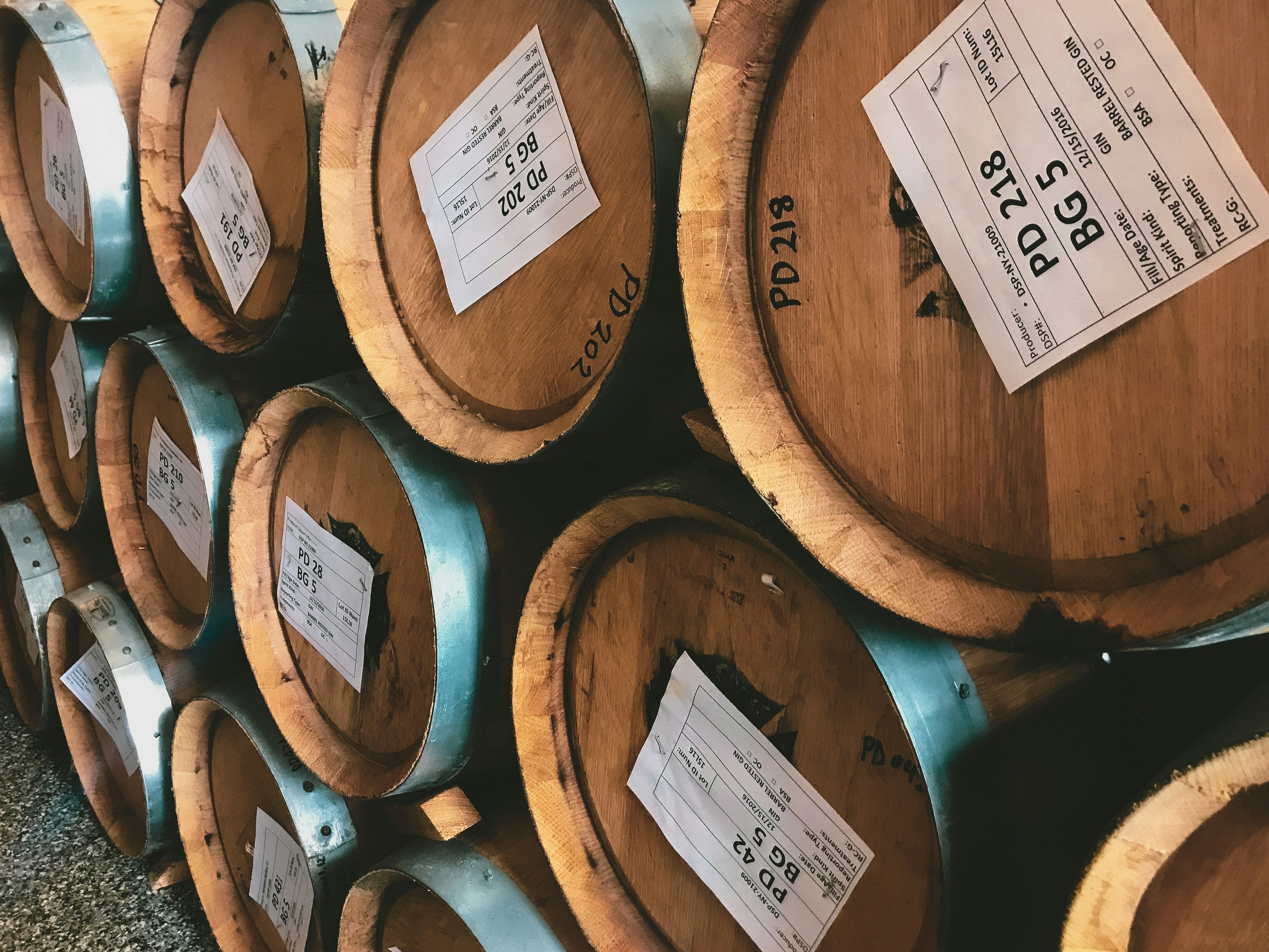
The "New Oak" Reactor
Why does the law mandate new charred oak? This is where the chemistry gets violent. When you char a barrel, you subject the wood to intense heat. This breaks down the lignins in the oak (the "glue" holding the tree together) and converts them into vanillin. It also caramelizes the hemicellulose into wood sugars, creating the "Red Layer" just beneath the char.
But there is a structural secret to why we use American White Oak specifically: tylosis.
White oak contains a membrane called tylosis that lies on the inner surface of the cells. When the tree is cut, the tyloses collapse and clog the cells. Because of this, when white oak is "quarter-sawn" and built into a barrel, it remains liquid-tight. Most other species—like red oak, pin oak, maple, or hickory—lack tylosis. No matter how you cut them, a barrel made from those woods will leak, making white oak the biological gold standard for aging spirits.
The Proof Point Shuffle
Pay attention here. This is where companies save money and cost you flavor.
-
Distillation Proof (Max 160): If you distill higher than this (like vodka, which is 190), you strip out all the flavor. The law forces you to leave the "congeners", the oils and esters that taste like grain, in the liquid.
-
Entry Proof (Max 125): This is the proof at which the liquid enters the barrel.
-
Bottling Proof (Min 80): The floor.
Here is the secret: water is free. Barrels are expensive.
Big industrial distilleries often distill to the max (160) and barrel at the max (125). Why? Because it takes fewer barrels to store high-proof alcohol. Then, years later, they dilute it with water down to 80 proof to fill more bottles. It’s efficient. It’s profitable.
But water and alcohol dissolve wood sugars differently. A lower entry proof (say, 105 or 110) extracts different, richer flavors. It’s less efficient, but it tastes better. The law sets the ceiling, but the integrity of the distiller determines if they hug that ceiling to save a buck or aim lower for quality.
"Straight" Bourbon: The Purity Standard
If you learn one thing from this article, let it be this. The word "Straight" on a label is your shield.
You might see a bottle labeled "Kentucky Bourbon Whiskey." Looks good, right? Maybe. Maybe not.
If it says "Straight Bourbon Whiskey," two things are legally guaranteed:
-
It has been aged for at least two years.
-
Zero additives. None. No color, no flavor, no blending materials.
The 2.5% Loophole (The Dirty Secret)
This is the part that makes people angry, and for good reason. Under 27 CFR 5.155, there is a provision for "harmless coloring, flavoring, and blending materials".
However, there is a major distinction to be made:
-
Bourbon Whiskey: By law, you cannot add these materials to any bottle labeled "Bourbon Whiskey," whether it is "Straight" or not.
-
Whiskey / Blended Whiskey: For spirits labeled simply as "Whiskey" or "Blended Whiskey," producers can add up to 2.5% by volume of these materials without disclosing it on the label.
In a 750ml bottle of blended whiskey, that is nearly 19ml of additives: a shot glass of syrup, prune juice, or chemical flavoring that you would never know about. While "Bourbon" is protected from this, many "Whiskey" brands use this loophole for "consistency," which we view as cutting corners. If you want to ensure you are drinking only grain, yeast, water, and wood, always look for the word "Straight" or "Bottled-in-Bond".
Bottled-in-Bond: The Code of Honor
In 1897, the whiskey market was a cesspool. Rectifiers were buying neutral grain spirits, basically rubbing alcohol, and dying it brown with tobacco spit, iodine, and burnt sugar. They sold it as "Old Farmhouse Bourbon." People were getting sick. Some were dying.
Col. E.H. Taylor Jr. didn't just want to sell whiskey; he wanted to protect the industry. He spearheaded the Bottled-in-Bond Act of 1897. It was the first consumer protection law in the history of the United States, predating the Pure Food and Drug Act.
When you see "Bottled-in-Bond," it is a guarantee of four things:
-
One Distillation Season: Produced between Jan-June or July-Dec. No blending vintages to hide a bad year.
-
One Distiller, One Distillery: You know exactly who made it.
-
Minimum 4 Years Age: Twice the requirement of Straight Bourbon.
-
Exactly 100 Proof: No watering it down to 80.
It was a badge of honor then. It is a badge of honor now. It represents accountability. In the military, you sign your name to your work. If you pack a parachute, you sign the log. Bottled-in-Bond is the distiller signing the log.
|
Requirement |
Standard Bourbon |
Straight Bourbon |
Bottled-in-Bond |
|
Min. Age |
None (technical) |
2 Years |
4 Years |
|
Additives |
Prohibited |
Prohibited |
Prohibited |
|
Proof |
Min 80 |
Min 80 |
Exactly 100 |
|
Distiller |
Can be blended/sourced |
Can be mixed (same state) |
One Distiller |
The Geography Myth: It Doesn't Have to be Kentucky
Let’s kill this sacred cow. I respect Kentucky. They make 95% of the world's bourbon. They have the limestone shelf, the history, and the infrastructure.
But the law does not require bourbon to be made in Kentucky.
Bourbon can be made in any state in the United States. From the dry heat of Texas to the humid coast of Florida, bourbon is a product of the U.S.A. In fact, the climate dictates the profile.
-
Kentucky: The baseline. Hot summers, cold winters. Balanced extraction.
-
Texas/South: Extreme heat. The liquid expands into the wood aggressively. You get dark, oak-heavy whiskey in fewer years.
-
North/New York: Slower aging. More oxidation. Subtle, floral notes.
Do not let a whiskey snob tell you it’s "not real bourbon" because it was distilled in Indiana or Colorado. If it follows the Federal Code, it’s bourbon. The location is just a variable in the flavor equation (terroir), not a legal constraint.
Reading the Label: How to Spot a Fake
You are standing in the aisle. You see a bottle with a nice label. It has a picture of a fictitious "Pappy Jethro" on the front and a story about a secret family recipe found in an attic.
Turn the bottle around. Look at the bottom of the label.
"Distilled By" vs. "Bottled By"
-
Distilled By [Company Name], [City, State]: This is the gold standard. The company on the label actually cooked the mash, ran the still, and filled the barrel. They made the juice.
-
Produced By / Bottled By / Packed By: This usually means they bought the whiskey from someone else. They are a Non-Distiller Producer (NDP).
There is nothing inherently wrong with sourcing whiskey. Some great brands started by curating excellent barrels from big industrial plants (like MGP in Indiana). But transparency matters. If a brand invents a fake history but is actually selling you industrial whiskey from a factory in another state, they are lying to you.
At Four Branches, we honor the truth. We don't hide where our spirits come from. You can find our bottles and see for yourself. Find a bottle of Four Branches near you to inspect a label in person.
The "State of Distillation" Rule
Here is a trick the shady brands use. If they bottle the whiskey in the same state where they bought it, they don't always have to list the state of distillation explicitly on the front. But if they bottle it in a different state, they must disclose it.
So if you see "Bottled in Florida" but the fine print says "Distilled in Indiana," you know you have a sourced product.
The Chemistry of Compliance
Why do we obsess over these rules? Because compliance creates flavor.
The mash bill (the grain recipe) is the start. The law says 51% corn. That provides the sweetness, the engine of alcohol production. But the other 49%? That is the artist's palette.
-
Rye: Adds the "burn," the pepper, the spice.
-
Wheat: Adds a creamy, soft texture (think Maker's Mark or Pappy).
-
Malted Barley: The enzyme kickstarter that converts starches to sugar, adding a nutty biscuit note.
We use a unique four-grain mash bill. We don't just stick to the minimums. By balancing all four grains, we tap into the full spectrum of flavor. But without the regulations enforcing the quality of those grains and the purity of the fermentation, the mash bill wouldn't matter.
The Rickhouse Effect
Once the whiskey is in the barrel, it goes to the rickhouse. This isn't just a warehouse; it's an oven and a freezer.
As the seasons change, the temperature inside the barrel fluctuates.
-
Heat: The liquid expands. It pushes deep into the wood pores, dissolving those red-layer sugars.
-
Cold: The liquid contracts. It pulls back out of the wood, bringing the flavor with it.
This "breathing" is what ages the whiskey. If you artificially control the climate to speed this up, you lose the complexity. The cycles of nature are part of the legal definition of the process. You cannot fake time.
The Final Pour
Regulations can feel restrictive. But in bourbon, they are the guardians of character. They ensure that when you crack the seal on a bottle of Straight Bourbon or Bottled-in-Bond, you are getting a product that hasn't been tampered with.
The market is flooded with celebrity brands and marketing gimmicks. Don't be a "tater", the guy chasing hype bottles he doesn't understand. Be a student of the craft. Read the label. Look for the "Straight" designation. Check the plant number. Ask the hard questions.
We fought for this country to protect its values. We distill our bourbon to protect its legacy.
Next time you pour a dram, don't just taste the vanilla and the oak. Taste the rules. They are the reason it’s good.
Ready to taste the difference integrity makes? Explore our spirits and see how a four-grain mash bill redefines the standard.